

Unity in the Community
Happy New Year! I’m excited about the possibilities 2018 has in store for us as a Church. This year’s focus is Building Unity in Community. We want to strengthen the unity we have as a Church community so that we can be a blessing to the community around us. We want to build bridges of unity with our neighbors as we strengthen our community in 2018.
Happy New Year! I’m excited about the possibilities 2018 has in store for us as a Church. This year’s focus is Building Unity in Community. We want to strengthen the unity we have as a Church community so that we can be a blessing to the community around us. We want to build bridges of unity with our neighbors as we strengthen our community in 2018.
I really enjoyed gathering around small tables this past Sunday with Brothers and Sisters to take the Lord’s Supper together as a Family. This is the center of who we are. We are people who are identified as those who participate in Christ’s death, burial, and resurrection. This New Life we receive comes with a New Family. Everyone in a family has something to give and also has needs to be fulfilled. We don’t walk alone with Christ. We walk as a Family. How will you get more involved in the Family this year?
What does it mean to be a community? Why does a community exist? Who does it serve? What about a community within a community?
This Sunday, I want to set the focus for the year by looking at Romans 12 together. I suggest reading the whole chapter all at once each day and then focusing on each section.
Romans 12:1-2
- What is true and proper worship?
- What does “offer your bodies as a living sacrifice” look like?
- How do you renew your mind? Read Philippians 2:5-11. How does this connect?
- What is your mind being renewed from?
- How will you know the will of God?
Romans 12:3-8
- What gifts have you been given? How can they be used at Queen City?
- Write down 3-5 people and the gifts you see them using at Queen City. Take a moment to pray for them.
- Are there people whom you do not know what their gifts are? Pray that God will open your eyes to the role they play in the body.
- What does this passage say about the need for community?
Romans 12:9-21
- What might change in your life if you committed this passage to memory?
- Which of these commands do you struggle with most?
- This passage looks at love in action. The call of the gospel is not to love better than the world does. We are called to love differently. How does our ability to love one another in the community affect our ability to love our neighbor? How is this love a witness to the world around us?

Christ in the World - A New Humanity
Last week we looked at the birth of Jesus in Luke’s Gospel and the hope the incarnation brings to the marginalized. While Luke’s Gospel focuses on Mary’s perspective of Jesus’ birth, Matthew approaches it from Joseph’s perspective. This week, I want to focus on what incarnational living means for the world around us, specifically for the powers of the world. I want to approach Matthew in a different way this week by first looking at Paul’s understanding of the Church in Ephesians.
Last week we looked at the birth of Jesus in Luke’s Gospel and the hope the incarnation brings to the marginalized. While Luke’s Gospel focuses on Mary’s perspective of Jesus’ birth, Matthew approaches it from Joseph’s perspective. This week, I want to focus on what incarnational living means for the world around us, specifically for the powers of the world. I want to approach Matthew in a different way this week by first looking at Paul’s understanding of the Church in Ephesians.
Ephesians 1:3-10
When Paul says we were predestined, he isn’t talking about one individual being chosen over another but that God’s plan from the beginning was that we (humanity) would be adopted as His Children.
- What is the mystery of God’s will, which he purposed in Christ?
- Who is excluded from adoption into the Family of God?
Ephesians 2:1-10
- How does one come into the Family of God?
- Knowing that we have the same entry point into the Family, how does this change how we approach diversity amongst people in the church?
- What does it look like for the Church to be “God’s handiwork”?
Ephesians 2:11-22
- What does it mean the Christ preached peace to those who were both far away and near?
- What message does this new Temple and new Citizenship proclaim to the powers of this world?
Ephesians 3:10-11
- What is the “manifold wisdom of God”?
- How does the church demonstrate the “manifold wisdom of God” to the rulers and authorities?
Matthew’s Gospel
Matthew’s Gospel begins with a genealogy that we mostly skip. There are four women referenced in this list. Each of them are gentiles and had questions of sexual purity surrounding them. Tamar slept with her father in law to provide a son. Rahab was a prostitute. Ruth “laid at the feet of Boaz,” (a common innuendo of that time) to convince him to take her in. Finally, Bathsheba’s name isn’t even mentioned which highlights David’s sinfulness in that event. What message(s) of hope do the women of Jesus’ genealogy give? How does this set up the story of Jesus’ birth and the controversy surrounding Mary? God works in incredible ways and uses messy situations to bring about glory and redemption.
Matthew 1:18-2:23
- Matthew frames his Gospel with calling Jesus “Immanuel,” God with us (1:23), and Jesus’ farewell to the Apostles in the Great Commission, “…I am wit you always…” (28:20) What hope and power does God’s presence give us in this world? Do you believe Jesus is with you? How would that belief/conviction change the way you live in community with others?
- Why does Matthew highlight this story that these foreigners travel a great distance to come and worship Jesus? How does this set up the ministry of Jesus? What does this say for the ministry of the church?
- Why is a baby such a threat to Herod that he kills so many children? Should the presence of Jesus be a threat to world power? Why?
- In what ways should the church be problematic for powers of this world? This question comes across a little odd. In what ways does/should the church live out the presence of God in this world that it subverts the “order” of the world around it? If Christ were to re-order society, what would it look like?
Christ in the World - Magnificat and Manger
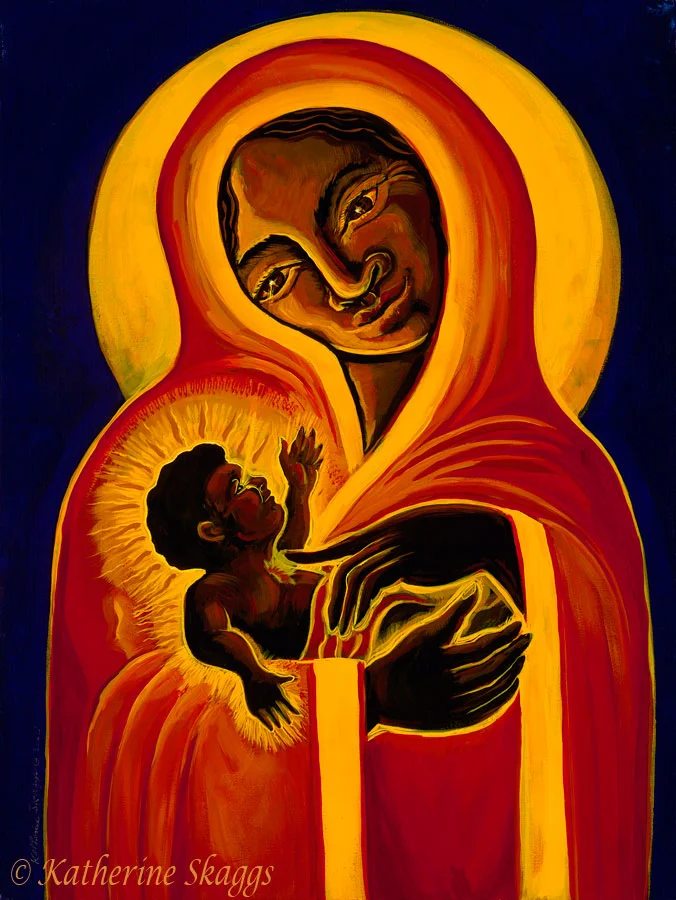
As we continue to focus on the reality of God becoming flesh in Jesus Christ, we shift our focus to the birth narratives over the next two weeks. Nick did an incredible job pointing us to being God’s presence to others as the “order” that came into the world. We are peace amongst the chaos of a broken creation. This week we shift our focus to Luke’s Birth Narrative and see what we can learn about how to be God’s presence in this world. Take time to read the first two chapters of Luke. You might read a different section each day and focus on what each story tells you about what God is doing in the world. Take a moment to consider the perspective of each character.
As we continue to focus on the reality of God becoming flesh in Jesus Christ, we shift our focus to the birth narratives over the next two weeks. Nick did an incredible job pointing us to being God’s presence to others as the “order” that came into the world. We are peace amongst the chaos of a broken creation. This week we shift our focus to Luke’s Birth Narrative and see what we can learn about how to be God’s presence in this world. Take time to read the first two chapters of Luke. You might read a different section each day and focus on what each story tells you about what God is doing in the world. Take a moment to consider the perspective of each character.
Between this week in Luke and next week in Matthew you’ll notice that the birth stories between the two gospels is quite different. This highlights how common the story of Jesus’ birth was when these gospels were written. Each writer is more concerned with highlighting aspects of the story to make larger points than to simply tell the story of what happened. So, as you read both Luke and Matthew, what point do you think they are making as they set the stage for Jesus’ ministry and ultimately his death, burial, and resurrection?
- What kind of anticipation does Luke build by withholding Jesus’ name for thirty verses?
- Look at the contrast between Zechariah’s response to God and Mary’s response. Place those responses within their context of who they are in society. Who is the hero between them? What grace and hope is Luke giving his readers who see the contrast between these two? What hope do you receive in these verses?
- Mary’s song is commonly called the Magnificat because that is the first word in the Latin. It is the gospel before the gospel, a fierce bright shout of triumph thirty weeks before Bethlehem, thirty years before Calvary and Easter. It is all about God it is all about revolution. What anthem of hope do you hear in her song? Who received the most hope from her message?
Chapter 2 begins with the adopted son of Julius Caesar, Augustus, flexing his little finger sending Jesus’ parents on a journey to Bethlehem where there was no guestroom for them to sleep in. The manger is mentioned three times in this passage. What is the significance of the manger? It is important for because it gives the shepherds their news and their instructions. It was a sign to the shepherds.
- The child they are to find is the savior, the Messiah, the Lord. It isn’t the manger that is important but who the manger points to. What is significant about the shepherds? What status do they have in society?
- We are called to be Christ in this world. When Luke tells the story of Christ’s humble beginnings, what does he tell us about how we are to be Christ in this world? Who are we to be Christ to when we realize that the shepherds are the first to behold God in the flesh?
Who are the other characters that stand out to you when Jesus is taken to the Temple?
- Simeon – Had the Holy Spirit on him, was righteous and devout.
- Anna – A prophet giving thanks to God and speaking about the child to all who were looking forward to the redemption of Jerusalem.
God coming in the flesh brings hope to the old who long for redemption and the widow who has dedicated her life to prophesy in the Temple. The Presence of God was brought to the Temple and she got to behold him. Who are you bringing the Presence of God to this week in your life?
Christ in the World - Word Became Flesh
There is a watershed movement among the friends and acquaintances of my generation. They are beginning to sell their houses and move across country (and in some cases across the world) so they can live closer to their children. In many cases the motivating factor is their love for their children and grandchildren and their desire to physically “be with them”. There is also the desire to help shape and impact the lives of their children & grandchildren. In other instances, their motivation is a hope for restoration—to mend broken relationships, seek healing, make peace, and reconcile with family members.
I am out of town this week for a wedding in Oklahoma. Our Brother, Nick, is continuing our series this Sunday and has graciously written a blog to prepare you for receiving a word from God this Sunday. I pray that your time in study and meditation will prepare you to be challenged and transformed further into the image of Christ. I'll see you next week!
Ryan
John 1:1-14.
There is a watershed movement among the friends and acquaintances of my generation. They are beginning to sell their houses and move across country (and in some cases across the world) so they can live closer to their children. In many cases the motivating factor is their love for their children and grandchildren and their desire to physically “be with them”. There is also the desire to help shape and impact the lives of their children & grandchildren. In other instances, their motivation is a hope for restoration—to mend broken relationships, seek healing, make peace, and reconcile with family members.
· What does John 1:1-14 say about why Jesus, God incarnate, moved across the universe from heaven to earth to live with his creation?
· What can we help impact and shape the lives of each other and those outside our church for Christ?
There was a friend of my father who would always drop by the house unannounced. When we opened the door to see who rang the doorbell, we would say something like, “Oh, it’s Mr. Summers.” or “Oh. Hi Mr. Summers.” Mr. Summers would always emphatically replied, “Yep! It’s me. In the flesh!”
Christmas is the day (and season) that celebrates the incarnation of Jesus. Or to put it another way, we celebrate Jesus being “God Incarnate”. The word “Incarnate” comes from Latin and means just what Mr. Summers always said, “Yes, it me, in the flesh!” I’m not saying Mr. Summers was God. However, they were both very much “In the Flesh”.
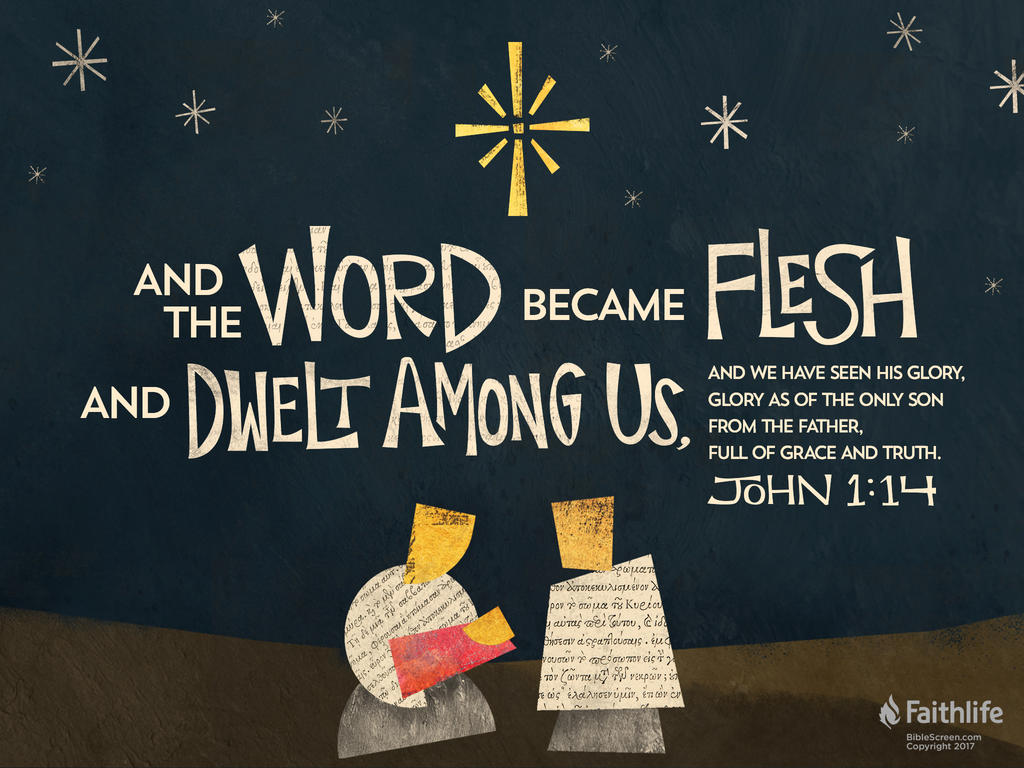
John 1:14 says that the Word (reason, rationale, order) came in the flesh and made his dwelling among us.
· What does it say about our God that he wants to become one of us and live with us?
God’s plan to live with his creation is not a new thing. In fact, the following scriptures show that throughout time, God has been relentless about dwelling with us.
· From the beginning God was physically present with Adam and Eve in the Garden (Gen 1-3).
· God’s presence was with the Israelites as they left Egypt (Ex 13:20-22)
· God dwelled with the wandering Israelites during their 40 years in the desert (Nu 9:15-23)
· God dwelled with the nation of Israel in the Temple built by Solomon (1Ki 8:10-11)
· Jesus was “God incarnate”. He took on flesh and lived as an Israelite. (Jn1:1-14; 1Jn 1:1-4)
· As believers and Christ-followers, the presence of God’s Holy Spirit dwells in us and outwardly reflects “God in us” to other people (1Cor 3:16)
· Jesus plans to come again and dwell with his followers for eternity. (Rev 21:3)
A common secular belief about God today is that He is some physically remote being, removed from and unconcerned with our everyday lives.
· In light of the above scriptures, how would you respond to that claim?
John 1:14 & 17 tells us that through the incarnation, Jesus brought “grace and truth” to mankind. These two small words make a statement that the Incarnation was indeed true and that Jesus brought both mercy and truth to the world.
· Describe in your own words the grace and truth that comes through Jesus?
· What does grace & truth look like when it effectively operates within the QC church body?
· What does grace & truth look like when it effectively operates within the NoDa community?
2Cor 3:17 says that Christians are being transformed increasingly into the likeness of Christ and thus reflect God’s glory–just as God’s glory was with the Israelites in the desert, and present in the Jerusalem Temple.
· What are some of the ways God has transformed your life to better reflect Christ to others?
· What part of your life today would you like transformed to better reflect glorify God?
1Cor 3:16 says that followers of Christ are now “God’s Temple”. In other words, Christians are God’s presence, that is “God in the flesh”, to others in the world. Similarly, 2 Cor 5:20 says that Christ-followers are “Christ’s ambassadors, as though God was making his appeal through us.”
· What does it mean to you to be God’s physical representatives to each other in the QC church community?
· What does it mean to you to be God’s physical representatives to the NoDa community?
Read 2 Cor 5:14-21 & Eph 2:10.
· What do these scriptures say about how God wants us to reflect his presence to others?
I look forward to our time together this Sunday. Please continue to pray about how you personally and we collectively can be the presence of God to one another and to the NoDa community.

Incarnation of Christ
Entering into the Christmas season should bring to mind the birth of Christ. Beyond the mass consumerism that has plagued our society is a reminder that God came down to be with us in the flesh so that we might become like him (2 Corinthians 5:21). God becoming flesh in Jesus Christ is called the “Incarnation.”
Entering into the Christmas season should bring to mind the birth of Christ. Beyond the mass consumerism that has plagued our society is a reminder that God came down to be with us in the flesh so that we might become like him (2 Corinthians 5:21). God becoming flesh in Jesus Christ is called the “Incarnation.” Exiled Jews looked forward to this day in Isaiah 52:1-12. When the Word became flesh (John 1:14), God made his dwelling with us (Matt 1:22 echoing Isaiah 7:14). Take a moment to read First John 1:1-10. Because of Jesus coming in the flesh, we have fellowship with God. In this fellowship, we are given new life lived as a testimony to a world in need of the presence of God. We become the presence of God to the world. For the month of December, I want to focus on what it means to be the incarnation today as we focus on the incarnation of God in the birth of Jesus Christ.
To prepare for this Sunday, I’m providing some passages for you to reflect on:
Colossians 1:15-23
- What does it mean for Jesus to be the image of the invisible God?
- What does it mean for us to be the body of Christ in respect to Christ being the image of God?
- In what ways can Queen City Church be the incarnation of God here in NoDa?
Hebrews 2:1-18
- What does it mean that Jesus became like us in every way?
- What is your emotional response to 2:11? Jesus calls us brothers and sister. How does this shape our identity as a Family?
- 2:15 – What does it mean to be free from being “held in slavery by their fear of death”?
John 14:15-31
- What does it mean that Jesus did not leave us as orphans?
- Take a moment to meditate and focus on 14:20 – “I am in my Father, and you are in me, and I am in you.” – What kind of relationship do we have with the Father, the Son, and with the Holy Spirit? How should this give you confidence to live the presence of Christ in this world?
- We’ve been given Christ’s peace (14:27). How does that speak to the chaos that comes up in life? What does it say to the pain and turmoil of this life? How is that a witness of the presence of God?
Paul looks to the incarnation as a model for how we should live our lives in relationship to one another. In Philippians 2:1-11, we’re called to have the same mindset of Christ in our attitudes towards one another. This is a mindset that is shaped by the experience of sacrificial living. You cannot just change your thinking. This mindset is developed through action. The church becomes the place where we develop the mindset of Christ so we can be the incarnation of Christ to a broken world in need of God’s presence. My prayer for us is that we become the embodiment of Isaiah 52:7 where people see us as beautiful because our lives are lived in the reality of the Good News we possess, we are people of peace, bringing good tidings, and proclaiming salvation.
Life of Thanksgiving - Responding to Critics
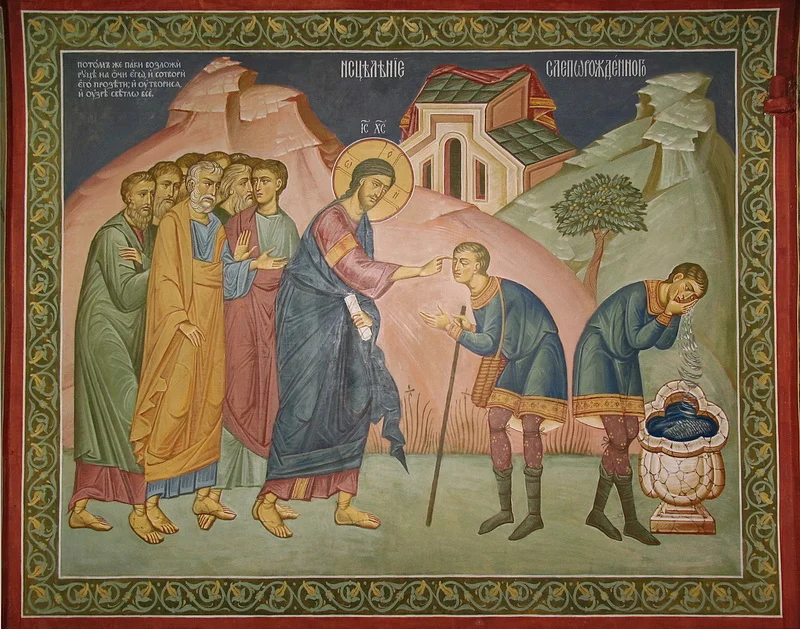
This week, I want us to look at two healings in the Gospel of John and how people respond to Jesus. There are a lot of characters in these stories but I specifically want you to focus on the paralytic in John 5:1-18 and the blind man in John 9:1-41. I don’t want to write a whole lot on this one because I’d love to hear what you’re seeing in the text. Here are some questions for while you’re reading.
With the leper who gave thanks to Jesus, we realize that we stand our tallest when we are face down at the feet of Jesus. A life of thanksgiving begins at the feet of Jesus.
The man who had the legion of demons found peace at the feet of Jesus. He was clothed, sitting, and in his right mind. Jesus sent him home to tell his people all that the Lord had done for him. From the feet of Jesus, a life of thanksgiving takes you home so you can share your story. Your greatest mission field is where you are.
This week, I want us to look at two healings in the Gospel of John and how people respond to Jesus. There are a lot of characters in these stories but I specifically want you to focus on the paralytic in John 5:1-18 and the blind man in John 9:1-41. I don’t want to write a whole lot on this one because I’d love to hear what you’re seeing in the text. Here are some questions for while you’re reading.
Which person responds with a response of true discipleship? How does the other one not give a response of true discipleship? How does that look in your life today?
What does the paralytic do to provoke Jesus to say, “Stop sinning or something worse may happen to you”? What social pressures is the man feeling? Which becomes more important to him: acceptance by the leaders of society or acceptance by Jesus? How does this look in our lives today?
What does it mean for the blind man to sell out everything for Jesus and only Jesus? What has he given up to be with the one who gave him his sight? What did the paralytic refuse to let go of?
When these two stories are held next to one another, they come to life in a whole new way. Take time to ready both of them each day this week and see what new things stand out to you. We had a great discussion this week in class about the legion of demons. It is always encouraging to hear what you get out of the text. What other questions do we need to ask of these passages? I look forward to being with you on Sunday as God speaks into our lives through his Word.
How are you responding to Jesus this week?
Life of Thanksgiving - Taking Thanksgiving Home
This week we are looking at one of my favorite stories, Mark 5:1-20. To get a more complete picture of what Mark is doing in this section, read Mark 4:35-5:43. Jesus encounters three forces that are completely out of our control: Nature, Spiritual Powers, and Death. There is a question of who Jesus is at the end of the calming of the storm, “Who is this? Even the wind and the waves obey him!” There is a call to faith in the midst of fear. Faith is the belief that God is working in and through Jesus Christ. Hebrews 11:1 defines it as, “confidence in what we hope for and assurance about what we do not see.” We all have things we are afraid of, things that motivate us negatively. What are some areas of your life that are out of your control where your faith needs to be strengthened?
Last week we looked at the story of the 10 lepers in Luke 17 and how a Life of Thanksgiving starts at the feet of Jesus. Jesus tells the Samaritan leper to “rise and go.” This New Life that is given in our participating in the Resurrection through the Holy Spirit begins with being face down at the feet of Jesus. Take time to give thanks to Jesus and intentionally place yourself at his feet. Here are three disciplines to help bring you to the feet of Jesus:
- Begin each day in prayer simply thanking God for who he has created you to be in Jesus Christ. You are His Child. His Son. His Daughter. He is very pleased with you!
- Sit down and write out your blessings from each day. Count them. Thank God for them.
- Pray continually what is called the “Breath Prayer” or “Prayer of the Heart” which is, “Lord Jesus Christ, Son of God, have mercy on me, a sinner.” Breath in and say, “Lord Jesus Christ, Son of God” which places him on his rightful throne. Breath out and say, “Have mercy on me, a sinner” which places you in your rightful position at his feet. Sit and breathe that prayer. Do it throughout the day to where when you recognize your breath you are then brought to the foot of the throne.
This week we are looking at one of my favorite stories, Mark 5:1-20. To get a more complete picture of what Mark is doing in this section, read Mark 4:35-5:43. Jesus encounters three forces that are completely out of our control: Nature, Spiritual Powers, and Death. There is a question of who Jesus is at the end of the calming of the storm, “Who is this? Even the wind and the waves obey him!” There is a call to faith in the midst of fear. Faith is the belief that God is working in and through Jesus Christ. Hebrews 11:1 defines it as, “confidence in what we hope for and assurance about what we do not see.” We all have things we are afraid of, things that motivate us negatively. What are some areas of your life that are out of your control where your faith needs to be strengthened?
I love the beautiful imagery Mark gives in 4:35-41, where the Creator God manifested in the Flesh stands amidst his broken creation that has given way to chaos and speaks order into it like he did in Genesis 1. “Quiet! Be still!” He commands it. He speaks to it. He is re-creating and subduing nature. We see the Kingdom of God breaking into this chaotic creation and speaking order into it. When Adam and Eve reached for the fruit of the Tree of Knowledge of Good and Evil they were telling God that they themselves can determine what is good and what is evil. Every time we try to play god and not let God be God, we send the God’s ordered creation into chaos. What areas of your life to do you need to let go of and let God speak order into it?
When Jesus said, “Let us go over to the other side” in 4:35, Jesus proposes that they go to the other side of the Sea of Galilee…to Gentile country. This is enemy territory. On the way into enemy territory, they go through a storm, which he stills. They dock the boat at a cemetery, next to a field of pigs. Is there anything here that stands out odd to you?
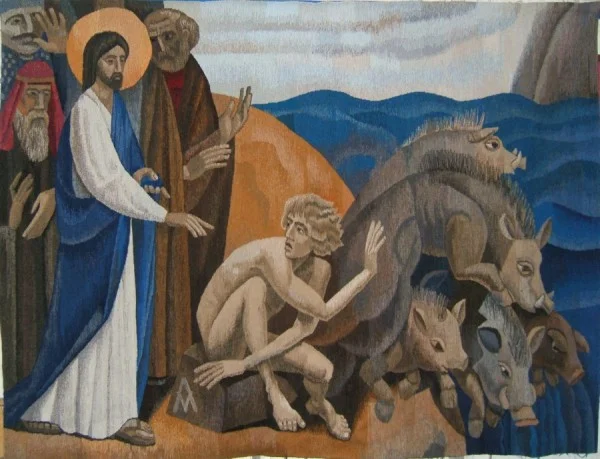
Jesus gets out of the boat and a bleeding, naked, crazy man runs up and throws himself at the feet of Jesus. Place yourself in the sandals of one of the apostles who are still in the boat watching. You just saw Jesus speak to nature and bring order to it and now a naked demon-possessed man who lives in a cemetery throws himself at the feet of Jesus and shouts at the top of his voice, “What do you want with me, Jesus, Son of the Most High God? In God’s name don’t torture me!” Jesus again speaks order into this man’s life calling the demon to come out.
Read 5:14-17. Why did they plead with Jesus to leave their region? What does that say about the power of Jesus and how terrifying it is? Whatever is going on inside of Jesus has this man, whom everyone knows was crazy demon possessed, seated calmly with his clothes on and in his right mind. When people end up at the feet of Jesus they move from chaos to peace. What areas of your life need to be placed at the feet of Jesus?
Look at the comparison between the stories of Demon possession in Mark 1 and 5. The first takes place on sacred soil in a sacred place (The Synagogue) and the other in an unclean land and an unclean place (Gentile country, in a cemetery, next to a field of pigs). Mark’s Gospel begins with Jesus silencing the demons who called out his identity. Jesus does not allow this man who had a legion of demons to go with him. Instead he sends him home with a message, “Go home to your own people and tell them how much the Lord has done for you, and how he has had mercy on you.” Jesus has crossed over to the land of the Gentiles and sends this man as the first apostle to the Gentiles (Apostle – “One who is sent”).
He goes to the Decapolis, the Ten Cities, who formed a defense league in the first century to protect themselves and they had a strong trading agreement. He came to the feet of Jesus in utter chaos and Jesus spoke peace and order into his life. He then gave him that message to take home. The man then went home and told everyone of the peace that came into his life because of Jesus. What areas of your life need to find peace at the feet of Jesus? What areas has Jesus brought peace? How do you share that testimony of peace with others?
1 Peter 3:15-16 – “But in your hearts revere Christ as Lord. Always be prepared to give an answer to everyone who asks you to give the reason for the hope that you have. But do this with gentleness and respect, keeping a clear conscience, so that those who speak maliciously against your good behavior in Christ may be ashamed of their slander.”
What message do you have for the hope that people see in you? In what ways is your hope visible to others?
From the feet of Jesus you take peace home with you and everywhere you go.

Life of Thanksgiving - At the Feet of Jesus
We’re in the season of thanksgiving and over the next few Sunday of November I want to focus on how people respond to Jesus and what it means to live a life of thanksgiving. We all welcome the grace and love Jesus has to offer but am I truly thankful for it in how I live? In how I love others? In how I treat others? In how I love my spouse? In how I treat my family? In how I love God’s Church?
We’re in the season of thanksgiving and over the next few Sunday of November I want to focus on how people respond to Jesus and what it means to live a life of thanksgiving. We all welcome the grace and love Jesus has to offer but am I truly thankful for it in how I live? In how I love others? In how I treat others? In how I love my spouse? In how I treat my family? In how I love God’s Church?
Jesus, in Luke’s Gospel, is on his way to Jerusalem. Luke has depicted Jesus eating with different people throughout his journey. Some were tax collectors and sinners and other meals were with the religious elite and the leaders of society. If you have some time, take a walk through Luke while paying attention to Jesus’ table fellowship and what takes place around food. When he eats with societal elites, he is hardly welcomed in with openness and love. He has the words of life but his hosts in these settings are often suspect of who he is. In turn, they receive challenges from Jesus as he speaks truth into their lives. Truth of who God is comes as inconvenient to those in positions of authority who have power to give up.
At the other end of a metaphorical table, Jesus is eating with the tax collectors and sinners. Jesus went to where people are. In their hurt. In their darkness. In the mess of their lives. I’m a firm believer that we should follow Jesus’ example here and meet people where they are and not where we are. Our Christian mission has often been oversimplified to “Invite Someone to Church” in hopes that they will hear a convicting message. What is fascinating about Jesus is that he does not set up shop in the Temple and invite everyone to come to him. He is the Temple and he takes the reality of God’s presence to people where they are. That being said, he meets people where they are, in love, with grace, but not with a call to change who they are in response to who he is. Zacchaeus, the wee little man, promised to give back four times the amount of anyone he has wronged. Jesus always meets them with grace, love, and respect, but also with a call to repentance and a call to righteousness.
Luke continually demonstrates that all are welcomed into the Kingdom. The only requirement is humility and repentance. The only entry point is to humbles yourself to God’s mercy and love. This offer is to everyone no matter what status one holds in this life. We’re only called to let God sit on the throne rather than sitting on the throne ourselves.
I want to focus this week on a story out of Luke 17:11-19. Jesus, heading towards Jerusalem and the fate that awaits him, travels along the border between Samaria and Galilee and encounters 10 leprous men. He doesn’t touch them like in Luke 5 but instead instructs them to go and show themselves to the priest. The priest is the only one who can reinstate them into society after declaring them clean. It does not say when they became clean but it had to have happened somewhere between when Jesus sent them and when they arrived before the priest. They had to act with obedient faith because they were cleansed along the way. They know who Jesus is. They recognized him and called out to him.
Obedience to follow Jesus from the point of being dirty to being made clean is an easy path to walk. He opens the waters of baptism to all people. Ten made the obedient walk towards cleansing but only one returned with thanksgiving. What does thanksgiving look like? How does he respond to Jesus? Was his thanksgiving a polite gesture in response to someone passing more turkey and stuffing at lunch?
Here is the question I want to wrestle with this month: What does a life of thanksgiving look like?
The walk with Christ begins with calling out for peace and mercy, a response of obedience to grace extended, and then a step towards Jesus in thanksgiving. The Spiritual life is born out of our remembrance of how we got to where we are in God’s Kingdom: Baptism through the grace extended by Jesus Christ. What is your response of thanksgiving?
What areas of your life demonstrate thanksgiving to the redemption you received in Jesus Christ? What areas of your life struggle to show thanksgiving towards Jesus?
Jesus gives us new life. New life is not a possession. It is, simply, new life. It is a new life of possibilities, of a new future that is developed day by day through decisions and actions. Life implies movement and growth. How does thanksgiving shape this new life?
““Spirituality” becomes far more than a science of interpreting exceptional private experiences; it must now touch every area of human experience, the public and social, the painful, negative; even pathological byways of the mins, the moral and relational world. And the goal of a Christian life becomes not enlightenment but wholeness.” – Rowan Williams
Your encounter with Jesus touches every aspect of your life. As you grow in this New Life, strive for wholeness as thanksgiving permeates every aspect of your life. Wake up every morning and thank Jesus for bringing you into the Family of God, the Chosen People, God’s special possession. We often go to God in prayer with requests of things we’d like fixed. Be sure to spend time thanking God for what he has done in Jesus Christ each day. I look forward to being with you this Sunday as we give thanks together!

The End of Time - Chapter 31
We’ve reached the end! The Book of Revelation is by far one of the most confusing books in the Bible. A lot of debate has swirled around this book and I don’t necessarily intend to sort out those debates. I do want to point to context, writing style, and genre to let you go back and read through Revelation on your own. We’ll get into a deeper discussion in class on Sunday. Please shoot me any questions you would like to discuss from Revelation. I look forward to our time together!
The Revelation of Jesus was written by John, who was quite possibly the same John who wrote the Gospel of John and the letters of John. In the opening paragraph, John tells us that he is writing an Apocalypse (translated – Revelation). An Apocalypse is a type of Jewish literature which would have been very familiar to John’s readers. They would have been familiar with other texts written in this same style: Ezekiel, Daniel, 4 Ezra, 1 Enoch. An Apocalypse is a recount of a prophet’s symbolic vision that reveals a heavenly perspective on history and current events so that the presents can be seen in perspective of history’s final outcome.
This Apocalypse is also a Prophesy (1:3), which is God’s word spoken through a prophet to warn or comfort them in a time of crisis. John is placing his writing within the tradition of the biblical prophets of the Old Testament but bringing their messages to a climax.
This Apocalyptic Prophesy we call Revelation was written as a letter to people whom John knew (1:4, 22:21). It was sent to seven churches in the province of Asia (Modern day Turkey). Seven is a big number for John. He weaves it into almost everything in his letter. In this style of writing, almost everything is symbolic. I’ve provided some notes below from a class I did on symbolism in Revelation for your own personal study. Seven is the number of completeness based on the Sabbath cycle. John uses these numbers and symbols, drawing on images from the Old Testament, to get his readers to go back and re-examine the Old Testament texts he is alluding to. The early church would have been familiar with these texts because it was the scripture they were reading. This is one of the main reasons I wanted us to work through The Story together so we could lay more of a foundation of the biblical story the early church was familiar with. Revelation was not written to be decoded two-thousand years later to predict the end of the world. John is speaking into the context of the churches in the province of Asia and still has a lot to say to us today, but we must read it within the context in which John writes it.
The letter begins with a vision of the risen Jesus! John is exiled on the island of Patmos and the church was undergoing persecution under the reign of Domitian. They had already been persecuted by Nero and the question we all must face is whether or not we will remain true to Christ when persecution comes. Jesus is standing amongst seven golden lampstands (reference to Zechariah 4) which represent seven churches. The letter starts with a reminder that the risen Jesus is “the First and the Last. I am the Living One; I was dead, and now look, I am alive for ever and ever! And I hold the keys of death and Hades.” This picture of Jesus and reminder of the reality of his resurrection comes with the proclamation, “Do not be afraid!” Read the letters to the churches. What is the mood of the letters? Are these churches undergoing persecution? Where is Jesus in these churches? Why would churches be persecuted? Is it possible for a church to not be worthy of receiving persecution?
Revelation, I believe, is written to encourage these churches (and us) to remember our first love, know where our hope is, and to live in such a way that we stand apart from the world. When we know who sits on the throne, everything else should come into perspective. The vision that follows the letters is of God on the throne in heaven and the slain Lamb opening the scroll. Revelation points to the dark powers that are behind every government that has ever ruled on this earth and reminds Christians where their allegiance resides. God is on his throne and at the end of Revelation, a New Heaven and a New Earth where God’s presence is with His people. When we encounter the chaos of this world, will be remain faithful to God on the throne or put our trust in the rulers of this world? When the church is moved to the margins of society and no longer has the power it once had, will we assimilate into the culture to not draw attention to ourselves or will we trust in God’s provision? When the world goes dark, we remember that we follow the Slain Lamb, the risen Lord, and we say, “Amen. Come, Lord Jesus. The grace of the Lord Jesus be with God’s people. Amen.”
Symbolism in Revelation
Here are some notes from a class I taught on symbolism in Revelation. I would not call it exhaustive but I leave it here for you to use in your own personal reading of Revelation:
Why use symbols?
- The symbols probably are not a secret language intended to conceal the message from potential enemies. Symbolism is simply the most appropriate language for conveying the fantastic and mysterious nature of what is being revealed. The symbols offer more vague association than direct correspondence, and even when we “get” the symbols, we may feel like there is much that we don’t understand. That is partly the point.
Some symbols are interpreted for us:
- Seven lampstands are churches; seven stars are angels (1:20)
- Four horses are conquest, slaughter, famine, death (6:1–8)
- Red dragon is Satan (12:9)
- Seven heads are seven mountains, but also seven kings (17:9–10)
- Ten horns are ten kings yet to receive their kingdoms (17:12)
- The woman is “the great city” (17:18)
Colors can have symbolic associations:
- White = victory or purity (1:14; 2:17; 3:4–5, 18; 4:4; 6:2, 11; 7:9, 13–14; 14:14; 19:11, 14; 20:11)
- Red = destruction (6:4; 12:3), bloodshed (6:12), re (9:17)
- Purple = royalty, luxury (17:4; 18:12, 16)
- Scarlet = perverse luxury (17:3–4; 18:12, 16)
- Black = mourning (6:5, 12)
- Pale green = death (6:8)
Numbers can have symbolic associations:
- 3 = the spiritual realm (8:13; 16:13; 21:13)
- 3 1/2 = tribulation (11:9; cf. Dan. 7:25; 9:27; 12:7); likewise, 1,260 days = 42 thirty-day months or 3 1⁄2 years (11:3; 12:6)
- 4 = the earth (4:6–8; 5:6, 8, 14; 6:1–8; 7:1–2, 11; 9:13–15; 14:3; 15:7; 19:4; 20:8; 21:16)
- 6 = failure (13:18 [three sixes])
- 7 = perfection or completion (1:4, 12, 16, 20; 3:1; 4:5; 5:1, 6; 8:2; 10:3; 11:13; 12:3; 13:1; 15:1, 7; 17:9); but sometimes 7 appears to signify Rome, which was built on seven hills (12:3; 13:1; 17:3, 7, 9, 11)
Numbers can have symbolic associations:
- 10 = totality (2:10; 12:3; 31:1; 17:3, 7, 12, 16)
- 12 = Israel (12:1; 21:12–14, 16, 21; 22:2); likewise 24 (4:4, 10; 5:8, 14; 11:16; 19:4) and 144 (7:4–8; 14:1–5; 21:17)
- 1,000 = a very great number; thousands of thousands = unimaginably large (5:11); 144,000 = a large Jewish multitude (7:4–8; 14:1–5); 7,000 = a “complete” large number, as many as necessary (11:13); 1,000 years = a very long time (20:2–7)
Imagery often recalls the Old Testament:
- Trumpet blasts (1:10; 4:1; 8:2–11:15): see Genesis19:16–19; Joel 2:1
- Blackened sun, moon like blood, falling stars (6:12–13): see Isaiah 13:10; 50:3; Joel 2:10
- Plagues (8:7–9:20): see Exodus 7:17; 9:18; 10:4, 21
- Hybrid beast (13:2): see Daniel 7:4–6
Some imagery is simply poetic and doesn’t appear to stand for anything specific:
- “a rainbow that looks like an emerald” (4:3)
- “a sea of glass, like crystal” (4:6)